A practical guide to specifying MIL-STD-1553 cable assemblies, covering cable types, lengths, connector configurations, and standard or custom options.
How to Specify Cable Type, Length and Connector Ends
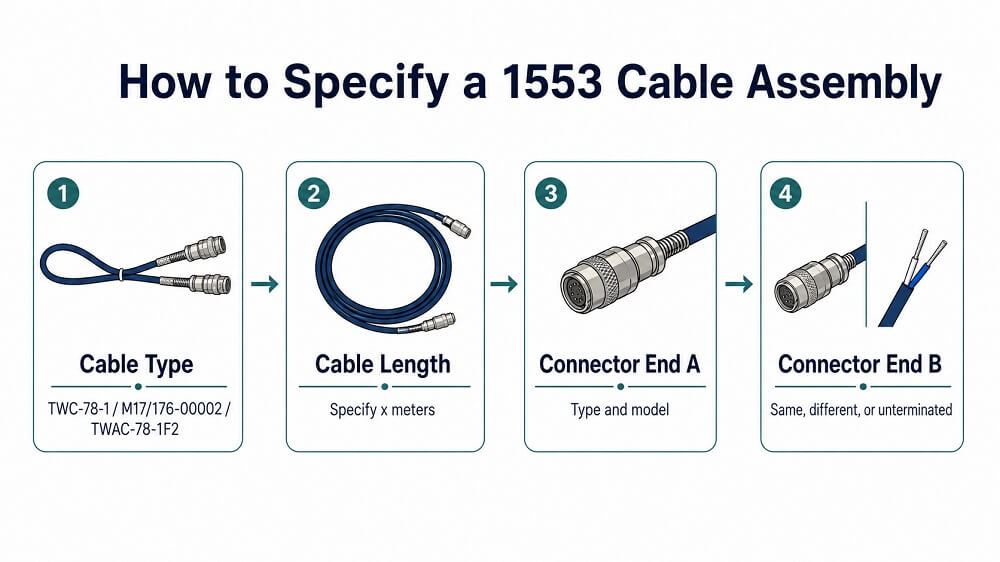
Ordering the wrong 1553 cable assembly usually doesn't show up until integration day: a connector that doesn't mate, a stub that's too long, or a cable that won't survive the environment. Most of these problems can be avoided by defining four things up front: cable type, length, and the connector at each end.
This guide explains how to specify a MIL-STD-1553 cable assembly and how to choose between Excalibur's standard configurations and a custom solution.
What Is a MIL-STD-1553 Cable Assembly?
A MIL-STD-1553 cable assembly is a ready-to-install twinax cable, cut to a defined length and fitted with the required connectors. Selecting the cable alone is only half the job. The assembly defines the complete physical connection.
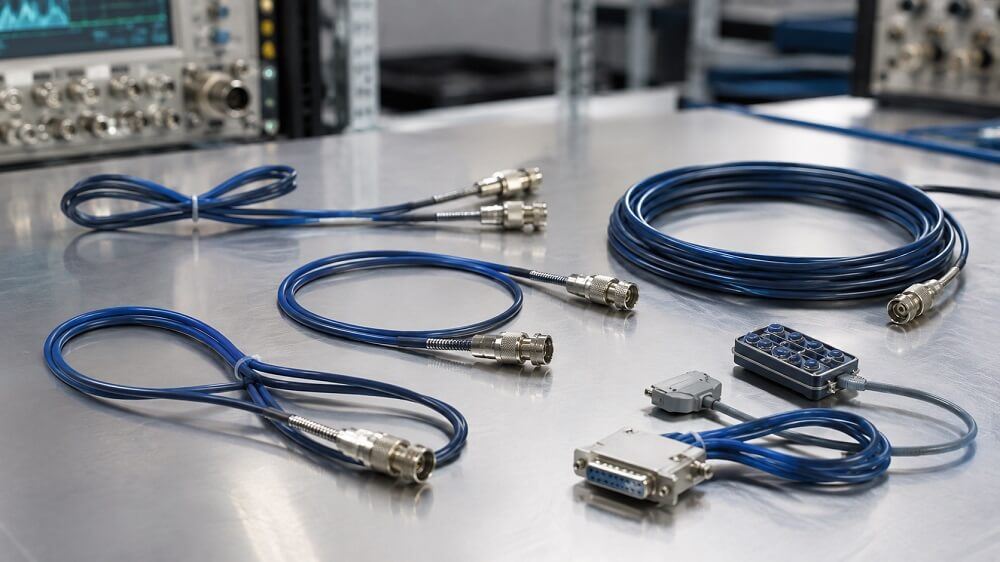
Common configurations include:
- The same connector on both ends
- Different connector types at each end
- A connector on one end and an open end (no connector) on the other
- A DB9 connector for specific equipment interfaces
- Custom adapting cables for dedicated equipment connections
Excalibur Standard 1553 Cable Assemblies
| Part Number |
End A |
End B |
Cable |
| X1AA1-(x) |
PL75-29 or equivalent |
Open end (no connector) |
TWC-78-1 (commercial) |
| X2AA1-(x) |
PL75-29 or equivalent |
PL75-29 or equivalent |
TWC-78-1 (commercial) |
| X2AA2-(x) |
PL75-49 or equivalent |
PL75-49 or equivalent |
TWAC-78-1F2 (200 °C) |
| X2BBM-(x) |
PL75-47 or equivalent |
PL75-47 or equivalent |
M17/176-00002 (MIL) |
| X1AA1BA1-(x) |
PL75-29 or equivalent |
CJ70-29 or equivalent |
TWC-78-1 (commercial) |
| X1DB1-(x) |
DB9 Male |
Open end (no connector) |
TWC-78-1 (commercial) |
(x) = cable length in meters.
Specifying Cable Length
Measure the actual routing path, not the straight-line distance. Allow for racks, panels, bend radius and space around the connectors, and avoid excess cable that has to be coiled.
In a MIL-STD-1553 network, length also affects bus performance. MIL-STD-1553B limits transformer-coupled stubs to about 20 ft (6.1 m) and direct-coupled stubs to about 1 ft (0.3 m). If the assembly is used as a stub, check its length against your coupling method. Use a maximum overall main bus length of 300 ft (91.4 m) as the design limit.
Connector on One End vs Both Ends
Assemblies with one open end, such as X1AA1-(x) and X1DB1-(x), are useful when the final connection is made during installation. Note that "open end" here means there is no connector on that end. It is not a bus termination, and the 1553 bus still needs proper 78 Ω terminators at each end of the main bus.
Assemblies with connectors on both ends (X2AA1, X2AA2, X2BBM) are plug-and-play between standard 1553 components such as couplers, terminators and interface cards.
Different Connector Types at Each End
Some installations need different connectors on opposite ends. For example, X1AA1BA1-(x) has a PL75-29 (or equivalent) on one side and a CJ70-29 on the other, using TWC-78-1 cable. This is a simple way to connect components with different connector interfaces.
Before ordering, confirm the connector type and mating compatibility at both ends, and above all the exact mating connector on any existing installation.
DB9 Assemblies
X1DB1-(x) has a DB9 connector on one end and an open end on the other. Because DB9 pin assignments vary between equipment, always confirm the pinout before ordering.
Choosing the Cable Type
The cable is selected together with the connectors and the operating environment:
- TWC-78-1: commercial twinax, well suited to lab and test use
- M17/176-00002: built to MIL-C-M17 specification
- TWAC-78-1F2: high-temperature twinax rated to 200 °C
For a detailed comparison, see our MIL-STD-1553 Cable Selection Guide.
When to Request a Custom Assembly
A standard assembly is the simplest option when an existing combination matches your project. A custom assembly is the better fit when:
- The connector combination you need isn't available as standard
- Your equipment uses a dedicated connector arrangement
- You need an adapting cable between specific equipment. Excalibur builds custom MIL-STD-1553 cable assemblies to customer requirements.
For more information and assistance with determining the appropriate custom part number, contact Excalibur Customer Support.
Checklist Before Requesting a Quote
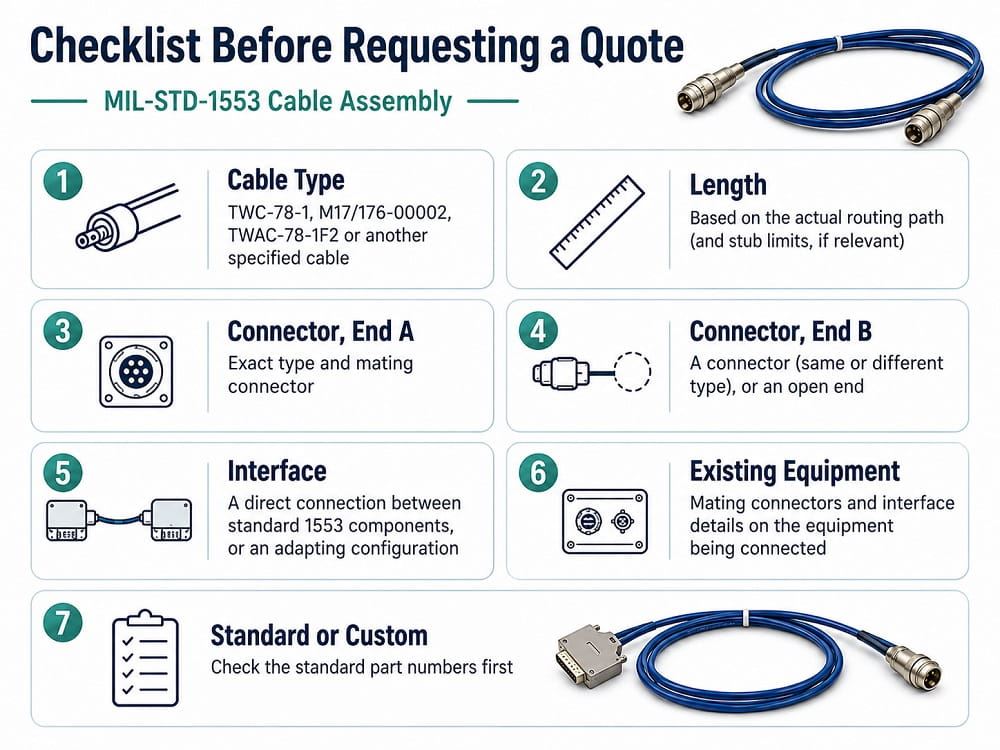
- Cable type: TWC-78-1, M17/176-00002, TWAC-78-1F2 or another specified cable
- Length: based on the actual routing path (and stub limits, if relevant)
- Connector, end A: exact type and mating connector
- Connector, end B: a connector (same or different type), or an open end
- Interface: a direct connection between standard 1553 components, or an adapting configuration
- Existing equipment: mating connectors and interface details on the equipment being connected
- Standard or custom: check the standard part numbers first
Get the Right Assembly the First Time
Send us the seven details above and we'll recommend the matching standard assembly, or define a custom one if needed.
View Excalibur's MIL-STD-1553 Standard Cable Assemblies | Request a Quote