Learn how to choose a MIL-STD-1553 cable for lab, integration, airborne and hi-temp applications, including twinax cables and cable assemblies.
Standard, MIL-Grade and Hi-Temp Twinax Cables
MIL-STD-1553 is one of the most widely deployed avionics and defense communication standards in the world. Developed to simplify the wiring of increasingly complex military and aerospace systems, the standard replaced numerous point-to-point signal connections with a single deterministic digital data bus.
By allowing multiple subsystems to communicate over a common network, MIL-STD-1553 significantly reduces wiring weight, installation complexity, maintenance effort, and overall system cost while improving reliability and fault isolation.
Today, MIL-STD-1553 networks are used in military and commercial aircraft, helicopters, naval vessels, armored vehicles, missiles, spacecraft, and ground support systems. In all of these applications, reliable communication depends not only on the bus controller, remote terminals, couplers, and connectors, but also on the physical cable infrastructure.
A critical component of the MIL-STD-1553 physical layer is the 78-ohm twinaxial cable used throughout the network. The cable provides controlled impedance, differential signal transmission, shielding from electromagnetic interference, and the mechanical robustness required for demanding aerospace and defense environments.
While MIL-STD-1553 cables may appear similar externally, significant differences exist between commercial, military-grade, and high-temperature cable constructions. Understanding these differences helps engineers select the most appropriate cable for their specific application.
What Is a MIL-STD-1553 Cable?
A MIL-STD-1553 cable is a shielded twinaxial cable designed to carry differential digital data signals between bus controllers, remote terminals, monitors, couplers, terminators, and test equipment connected to a MIL-STD-1553 network.
Unlike conventional single-conductor cables, twinax cable contains two insulated conductors enclosed within a common shield. The cable is specifically designed to provide a nominal characteristic impedance of 78 ohms, which is required for proper operation of the MIL-STD-1553 physical layer.
Differential Signaling
MIL-STD-1553 uses differential signaling, meaning that data is transmitted as the voltage difference between two conductors rather than as a voltage referenced to ground.
In Excalibur cable assemblies:
- Blue conductor = Bus High (HI)
- White conductor = Bus Low (LO)

This differential transmission method provides excellent immunity to external electrical noise and minimizes susceptibility to electromagnetic interference (EMI), electromagnetic pulse (EMP), and crosstalk from nearby wiring.
Combined with the cable shield, differential signaling allows MIL-STD-1553 networks to operate reliably in electrically noisy environments such as aircraft, naval platforms, and military vehicles.
Why 78 Ohms?
The characteristic impedance of the cable is one of the most important parameters in a MIL-STD-1553 network.
The standard was designed around 78-ohm twinax cable to provide predictable transmission-line behavior throughout the bus.
Maintaining the proper impedance minimizes signal reflections, preserves waveform integrity, and ensures reliable communication between all devices connected to the network.
Because the cable forms part of the transmission system, impedance mismatches introduced by improper cable selection, connectors, or terminations can negatively affect overall bus performance.
Why Cable Selection Matters
Engineers sometimes focus primarily on interface cards, couplers, or software while viewing the cable as a simple interconnect. In reality, the cable is a critical component of the MIL-STD-1553 physical layer and directly influences overall system performance.
When selecting a cable, several factors should be considered:
The cable must maintain the required 78-ohm impedance and support reliable differential signal transmission throughout the network.
Proper shielding protects the bus from external electromagnetic interference and reduces the possibility of communication errors.
The cable must withstand handling, installation, vibration, and long-term operational stress without degradation.
Cable diameter, flexibility, and bend radius affect routing through equipment bays, conduits, and densely packed electronic systems.
- Environmental Requirements
Temperature, humidity, vibration, chemicals, and other environmental factors can significantly influence cable selection.
Choosing the wrong cable may lead to signal integrity problems, installation difficulties, or premature cable failure.
Comparison of Available MIL-STD-1553 Cable Types
Excalibur offers three primary twinax cable options for MIL-STD-1553 applications:
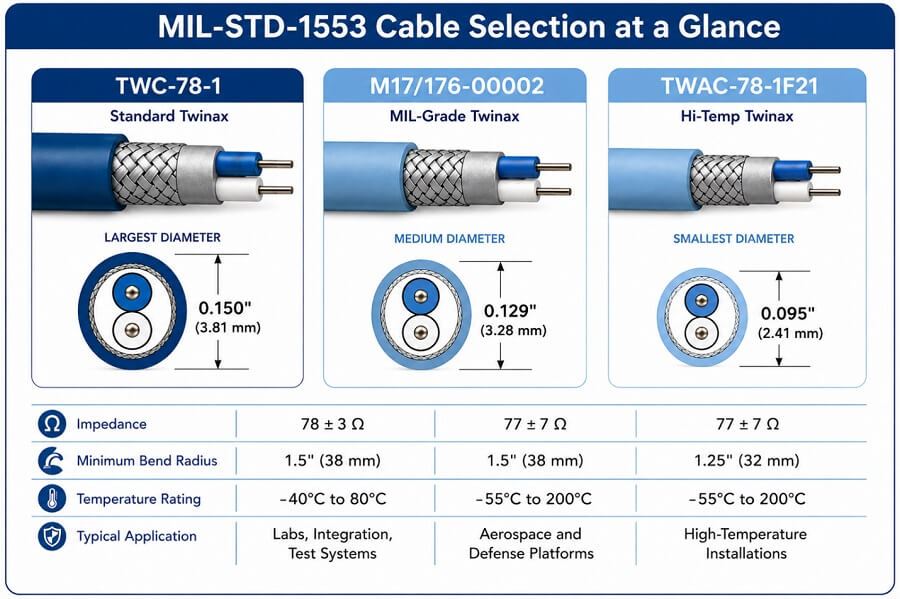
Standard Twinax Cable – TWC-78-1
TWC-78-1 is a practical and economical cable option for general MIL-STD-1553 applications.
With an outside diameter of 0.150 inches, it is the largest of the three cable types discussed in this guide. The larger diameter contributes to mechanical robustness while still maintaining sufficient flexibility for laboratory and integration environments.
Typical applications include:
- Laboratory test setups
- Integration benches
- Production testing
- System development
- General-purpose cable assemblies
For many engineering environments, TWC-78-1 provides an excellent balance between durability, flexibility, and cost.
MIL-Grade Twinax Cable – M17/176-00002
M17/176-00002 is a military-grade twinax cable manufactured to military cable specifications.
Compared to the commercial TWC-78-1 cable, it features a slightly smaller diameter of 0.129 inches while maintaining the same 78-ohm impedance and 1.5-inch minimum bend radius.
MIL-grade cable is often selected when:
- Military specifications must be satisfied
- Platform qualification requirements exist
- Additional environmental robustness is required
- Long-term aerospace supportability is important
Typical applications include military aircraft, naval systems, ground vehicles, and other defense-related platforms.
Hi-Temp Twinax Cable – TWAC-78-1F21
Some installations expose cable assemblies to elevated temperatures that exceed the capabilities of conventional cable constructions.
For these applications, Excalibur offers TWAC-78-1F21 high-temperature twinax cable.
This cable combines:
- 78-ohm MIL-STD-1553 compatibility
- Operation at temperatures up to 200°C
- Reduced outside diameter of 0.095 inches
- Tight 1.25-inch minimum bend radius
The smaller diameter and tighter bend radius simplify routing through confined spaces while maintaining the thermal performance required for demanding installations.
Typical applications include:
- Engine compartments
- Power electronics bays
- Thermal control systems
- High-temperature aerospace environments
- Harsh industrial platforms
Cable Diameter and Bend Radius Considerations
Cable Diameter and Bend Radius ConsiderationsCable diameter is often overlooked during the early stages of system design. However, it can have a significant impact on installation complexity.
TWC-78-1
The largest diameter cable in this comparison. It provides excellent durability and handling characteristics for general engineering use.
M17/176-00002
Offers military-grade performance while reducing overall cable size compared to the commercial option.
TWAC-78-1F21
The smallest cable diameter among the three options. This can simplify routing in constrained installations and reduce overall cable bundle size. In addition to diameter, engineers must consider minimum bend radius.
Exceeding the recommended bend radius may:
- Damage the cable structure
- Alter electrical characteristics
- Reduce long-term reliability
- Increase the likelihood of intermittent failures
Following manufacturer bend-radius recommendations helps maintain both electrical and mechanical performance.
Cable Assemblies
Many users require complete cable assemblies rather than bulk cable.
A cable assembly combines:
- Twinax cable
- Connectors
- Strain reliefs
- Identification marking
Properly assembled cables reduce installation errors, improve repeatability, and simplify procurement.
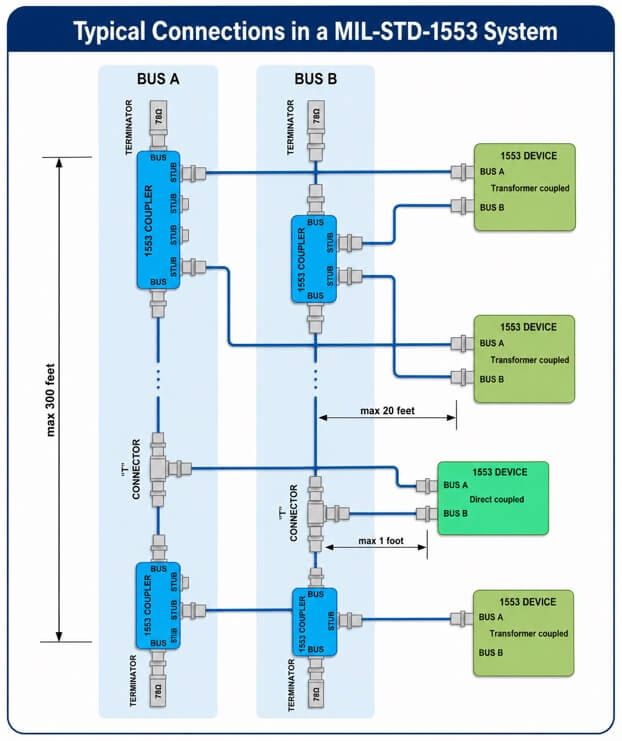
Practical Selection Checklist
Before selecting a cable or cable assembly, consider the following questions:
- Is the installation located in a laboratory, integration environment, or deployed platform?
- Is a military-qualified cable required?
- Will the cable be exposed to elevated temperatures?
- What cable diameter is acceptable?
- Are routing constraints present?
- What minimum bend radius can be accommodated?
- Which connector types are required?
- What environmental conditions will the cable experience?
- Is a custom cable assembly required?
Answering these questions early in the design process helps avoid costly redesigns and installation issues.
Conclusion
MIL-STD-1553 cable selection involves more than simply choosing a cable that supports the protocol. The cable is a fundamental component of the physical layer and plays a direct role in signal integrity, EMI immunity, mechanical reliability, and long-term system performance.
All three Excalibur cable options—TWC-78-1, M17/176-00002, and TWAC-78-1F21—provide the 78-ohm differential twinax construction required for MIL-STD-1553 communication. The optimal choice depends on the environmental, mechanical, and operational requirements of the specific application.
By understanding cable impedance, differential signaling, shielding, diameter, bend radius, and temperature capability, engineers can select a cable solution that delivers reliable MIL-STD-1553 performance throughout the life of the system.
Discuss Your MIL-STD-1553 Cable Requirements