Learn how CAN FD fits into modern avionics systems, how it differs from Classical CAN and ARINC 825, and what engineers should consider when testing CAN FD in mixed avionics environments.
Avionics systems are becoming more distributed, more data-intensive and more dependent on efficient communication between electronic subsystems. While established protocols such as MIL-STD-1553, ARINC 429 and ARINC 717 continue to play an essential role in aircraft and defense platforms, engineers are also evaluating newer communication options that can support higher data throughput, more flexible architectures and compact embedded designs.
One of these technologies is CAN FD, short for CAN with Flexible Data-Rate. CAN FD builds on the familiar Controller Area Network concept, but extends it with a larger payload capacity and faster data transmission during the data phase. These characteristics make it especially relevant for applications where classical CAN may be too limited, but where a lightweight, robust and distributed communication approach is still desirable.
In aerospace and avionics environments, CAN FD is not simply a faster version of CAN. It raises important engineering questions around timing, interoperability, bus loading, system validation and coexistence with other avionics protocols. It is also becoming part of broader industry discussions around future avionics test interfaces. For example, Excalibur Systems included CAN FD among the technologies highlighted in its March 2026 roadmap update, alongside other next-generation interface considerations such as ARINC 818 and updated PXI/PXIe support.
This article explains what CAN FD is, why it matters for avionics, how it compares with Classical CAN and ARINC 825, and what engineers should consider when testing CAN FD in mixed-protocol aerospace systems.
What Is CAN FD?
CAN FD is an extension of the Classical CAN protocol. It was developed to address two major limitations of Classical CAN: limited payload size and limited data throughput.
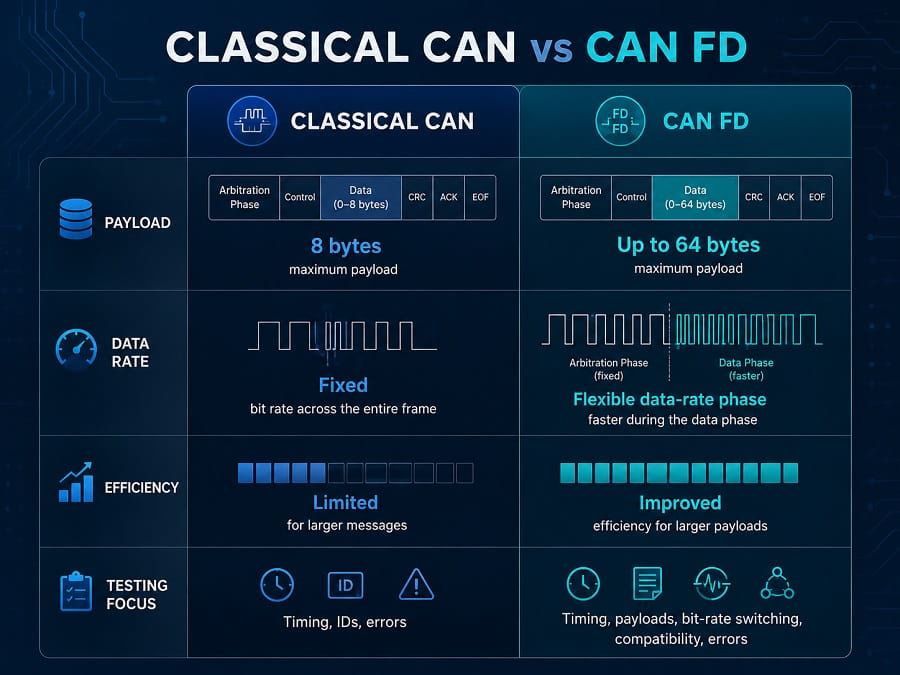
Classical CAN supports a maximum data payload of 8 bytes per frame. CAN FD increases the maximum payload to 64 bytes, allowing more data to be transmitted in a single frame. CAN FD also allows a higher bit rate during the data phase, while retaining an arbitration phase that remains compatible with CAN bus principles. CAN in Automation describes CAN FD as overcoming the two Classical CAN limits of payload length and transmission speed, with payloads up to 64 bytes. (CAN in Automation)
In simple terms, CAN FD allows engineers to move more data with better efficiency while preserving many of the architectural advantages that made CAN useful in the first place.
For avionics engineers, this matters because aircraft and mission systems increasingly include distributed electronic units, sensors, control modules and embedded subsystems that may need to exchange more information than Classical CAN can efficiently support.
CAN FD vs Classical CAN: Key Technical Differences
Although CAN FD is based on the CAN concept, it introduces several important differences that affect system design, testing and validation.
| Feature |
Classical CAN |
CAN FD |
| Maximum data payload |
8 bytes |
Up to 64 bytes |
| Bit rate behavior |
Fixed bit rate across the frame |
Flexible data rate, with faster data phase |
| Data efficiency |
Limited for larger messages |
Improved efficiency for larger payloads |
| CRC mechanism |
Classical CAN CRC |
Enhanced CRC for larger frames |
| Use case fit |
Lower-data distributed control |
Higher-data distributed communication |
| Testing focus |
Arbitration, IDs, timing, errors |
All Classical CAN factors plus payload size, data phase timing and compatibility |
The key difference is not only speed. The larger payload changes how engineers may structure messages, reduce frame overhead and manage bus utilization. However, it also means test tools must correctly interpret CAN FD frames, data length codes, bit rate switching and payload handling.
A system that appears stable under Classical CAN conditions may require additional validation when CAN FD is introduced, especially if the network includes mixed node capabilities or strict timing requirements.
Why CAN FD Matters in Aerospace and Avionics
Aerospace systems often evolve over long lifecycles. Legacy buses may remain in use for decades, while newer electronic subsystems are added to meet modern performance, sensing, control or mission requirements. This creates a mixed environment where different communication standards must coexist.
CAN FD can be relevant in avionics and aerospace applications because it supports several industry needs:
- Higher Data Throughput
Modern electronic subsystems often need to exchange more data than earlier generations of equipment. CAN FD allows larger frames and faster data transmission during the data phase, which can improve efficiency when sending diagnostic data, sensor values, status information or control-related messages.
- Distributed System Architectures
Aircraft, UAVs, ground support systems and mission platforms often use distributed electronics. CAN-based communication can be useful where multiple nodes need reliable communication without the complexity or overhead of larger network architectures.
- Compact Embedded Designs
CAN FD can fit well in embedded environments where space, weight, power and wiring complexity matter. This can be especially relevant in compact avionics modules, unmanned systems and distributed control applications.
- Evolution from Existing CAN-Based Systems
For systems that already use CAN or aviation-specific CAN implementations, CAN FD may be evaluated as a potential path for higher capacity while preserving familiar engineering concepts.
The practical question is not whether CAN FD replaces established avionics protocols. In many systems, it will not. The more realistic question is how CAN FD can coexist with MIL-STD-1553, ARINC 429, ARINC 825, Ethernet, serial communication and discrete I/O in a complete avionics architecture.
CAN FD and ARINC 825: Understanding the Relationship
CAN FD and ARINC 825 are related topics, but they are not the same thing.
ARINC 825 is an aerospace-focused standard based on CAN. SAE describes ARINC 825 as defining a Controller Area Network interface for current and future commercial aircraft applications. (SAE International)
This is important because aerospace systems require more than a raw communication protocol. They often require standardization around interoperability, message structure, network behavior and implementation practices suitable for airborne use.
CAN FD, on the other hand, refers to the extended CAN protocol capability that enables larger payloads and flexible data rates. It describes how CAN communication can carry more data more efficiently, but it does not automatically define the full aerospace usage model by itself.
Practical Difference
A simplified way to understand the difference:
- CAN FD addresses protocol-level capability, especially payload size and data phase speed.
- ARINC 825 addresses the use of CAN in aviation and aircraft-related environments.
For engineers, this distinction matters during specification, procurement and testing. A project may ask whether a system supports CAN, CAN FD, ARINC 825 or a specific aerospace CAN implementation. These are not interchangeable requirements.
Why This Matters for Testing
When testing a CAN FD system in an aerospace context, engineers should confirm:
- Whether the requirement is generic CAN FD or an aviation-specific CAN implementation
- Whether Classical CAN and CAN FD nodes coexist on the same network
- Whether message definitions, identifiers and timing behavior are clearly specified
- Whether the test system can decode and validate the required frame types
- Whether the data must be correlated with other avionics buses
This is where many integration problems begin. The protocol name alone is rarely enough. Engineers need to understand the specific implementation, message behavior and system architecture.
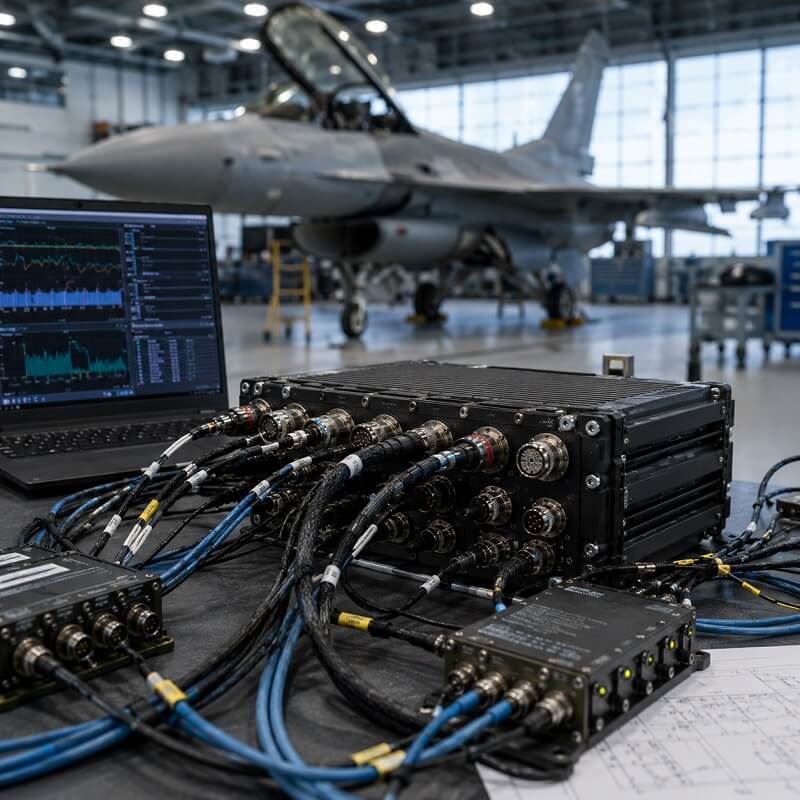
Key Engineering Challenges When Working with CAN FD
CAN FD can offer clear advantages, but it also introduces validation challenges that should be addressed early in the project.
1. Timing Validation
CAN FD uses different timing behavior between the arbitration phase and the data phase. This means engineers must pay close attention to bit timing, sample points, data phase rates and synchronization. A network that works under one configuration may become unstable if timing parameters are not aligned across devices.
2. Bus Load and Network Utilization
Because CAN FD supports larger payloads, engineers may be tempted to place more data into each frame. While this can improve efficiency, it can also affect bus load, latency and system behavior under peak traffic conditions.
Testing should include realistic traffic scenarios, not only ideal low-load conditions.
3. Payload Decoding
Larger payloads mean more complex data structures may be packed into a single frame. Test tools must support correct decoding, interpretation and display of payload data. This is especially important when engineers need to convert raw values into engineering units or correlate CAN FD traffic with other system events.
4. Compatibility with Classical CAN
CAN FD controllers can often support Classical CAN communication, but mixed-network behavior requires careful planning. Not every Classical CAN node can interpret CAN FD frames. Engineers must verify whether the network is purely CAN FD, Classical CAN only, or a controlled combination of both.
5. Error Handling
Error behavior, CRC validation and fault conditions should be tested carefully. Larger payloads and higher data phase rates can make it even more important to detect and analyze errors accurately.
6. System-Level Correlation
In avionics, CAN FD data may need to be understood alongside MIL-STD-1553 messages, ARINC 429 labels, Ethernet packets, serial communication or discrete signals. Testing CAN FD in isolation may not reveal how the complete system behaves.
Testing CAN FD in Mixed Avionics Environments
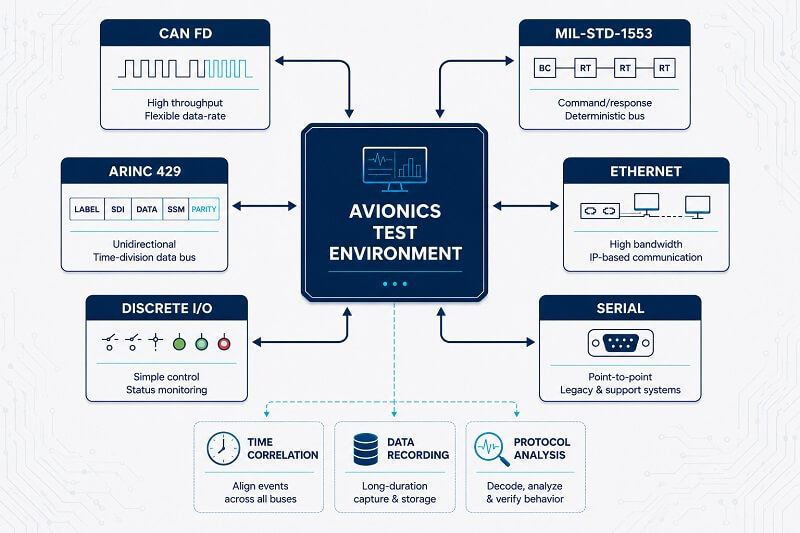
In real avionics systems, CAN FD will rarely be the only communication interface. A platform may include several generations of technology operating together. For example:
- MIL-STD-1553 may handle deterministic command and control communication.
- ARINC 429 may transmit point-to-point avionics data.
- ARINC 825 or CAN-based systems may support distributed communication between electronic units.
- Ethernet-based interfaces may support higher-volume data exchange.
- Discrete I/O may still be used for simple control or status signals.
- Serial communication may remain present in support equipment or legacy subsystems.
This creates a testing challenge. Engineers must validate not only each protocol individually, but also the relationships between them.
A CAN FD message may trigger a response on another bus. A status change on a discrete line may correspond to a change in CAN FD traffic. A protocol converter may need to translate data between CAN FD and another avionics interface. A data recorder may need to capture synchronized traffic from several sources.
For this reason, effective CAN FD testing in avionics should consider:For this reason, effective CAN FD testing in avionics should consider:
- Multi-protocol visibility
- Time correlation between interfaces
- Accurate frame decoding
- Long-duration recording
- Traffic simulation
- Error and fault analysis
- Conversion or gateway behavior
- Repeatable test scenarios
The more mixed the environment becomes, the more important it is to evaluate CAN FD as part of the complete system, not as an isolated bus.
CAN FD Protocol Conversion Considerations
Protocol conversion is often needed when a CAN FD subsystem must exchange data with equipment using another avionics protocol. This may involve conversion between CAN FD and MIL-STD-1553, ARINC 429, Ethernet, serial communication or discrete I/O.
However, protocol conversion is not just a matter of changing electrical interfaces. It often requires careful data mapping and system logic.
Engineers should define:
- Which CAN FD frames must be converted
- How identifiers map to destination messages
- How payload fields map to other protocol formats
- Whether timing constraints apply
- Whether messages should be filtered, aggregated or split
- How errors and invalid data should be handled
- Whether conversion must occur in real time
This is especially important because CAN FD payloads can be larger than Classical CAN payloads. A single CAN FD frame may contain data that must be separated into several output messages when converted to another protocol.
Good conversion design begins with a clear interface control document, a complete data mapping table and a validation plan that tests normal, edge and failure scenarios.
CAN FD Testing Checklist for Avionics Engineers
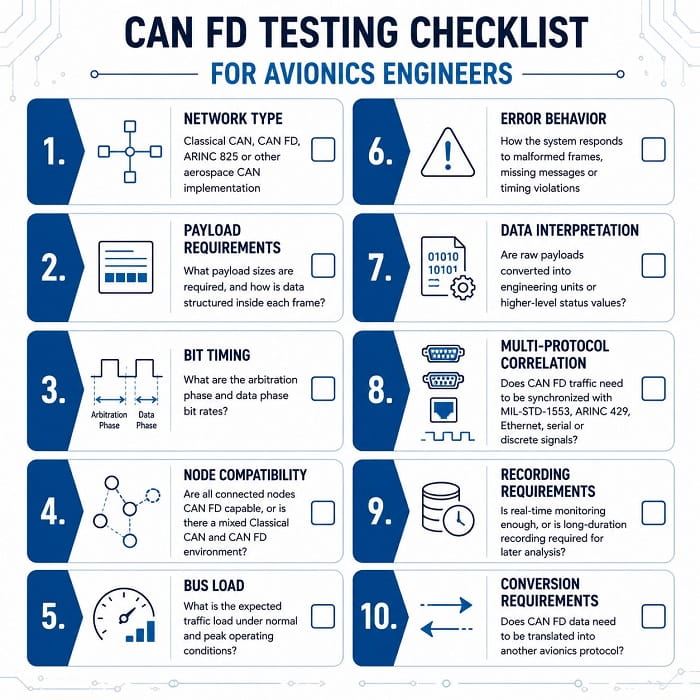
Before validating a CAN FD implementation, engineering teams should clarify the following:
- Network Type
Is the system using Classical CAN, CAN FD, ARINC 825 or another aerospace CAN implementation?
- Payload Requirements
What payload sizes are required, and how is data structured inside each frame?
- Bit Timing
What are the arbitration phase and data phase bit rates?
- Node Compatibility
Are all connected nodes CAN FD capable, or is there a mixed Classical CAN and CAN FD environment?
- Bus Load
What is the expected traffic load under normal and peak operating conditions?
- Error Behavior
How should the system respond to malformed frames, missing messages or timing violations?
- Data Interpretation
Are raw payloads converted into engineering units or higher-level status values?
- Multi-Protocol Correlation
Does CAN FD traffic need to be synchronized with MIL-STD-1553, ARINC 429, Ethernet, serial or discrete signals? multi protocol boards >>
- Recording Requirements
Is real-time monitoring enough, or is long-duration recording required for later analysis?
- Conversion Requirements
Does CAN FD data need to be translated into another avionics protocol? MACC - Protocol Converter >>
This checklist helps shift CAN FD testing from simple message observation to system-level validation.
What the Industry Is Watching Next
The growing interest in CAN FD reflects a broader trend in avionics communication. Engineers are no longer working only with one protocol family or one generation of system architecture. Instead, they are dealing with mixed platforms that combine legacy buses, modern embedded electronics, higher data volumes and more compact integration requirements.
This is why CAN FD is appearing in roadmap conversations across the test and integration ecosystem. In March 2026, Excalibur Systems noted that it is evaluating new technical directions that include CAN FD, ARINC 818, updated PXI/PXIe support and a new Inline MACC concept for high-density integration. (Mil-1553)
For engineers, the takeaway is practical: CAN FD should be evaluated not only as a protocol feature, but as part of a future-ready avionics test strategy. The question is not simply whether a tool can read CAN FD frames. The real question is whether the test environment can help engineers understand CAN FD behavior within the full avionics system.
Conclusion
CAN FD offers a meaningful evolution of CAN-based communication by supporting larger payloads and faster data transmission during the data phase. For aerospace and avionics applications, this can be valuable in distributed systems, embedded electronics, UAV platforms, mission systems and next-generation test environments.
However, the benefits of CAN FD come with engineering responsibilities. Timing, bus load, compatibility, payload decoding, error handling and multi-protocol correlation all need to be tested carefully.
As avionics systems continue to combine established standards with newer communication technologies, CAN FD is likely to become an increasingly relevant part of the conversation. Engineers planning future systems should evaluate CAN FD not only for its data capacity, but for how well it integrates into the complete avionics communication environment.
Discuss Your Avionics Test Requirements
FAQ
What is the main advantage of CAN FD in avionics systems?
The main advantage is that CAN FD can carry more data per frame than Classical CAN while supporting a faster data phase. This can help reduce message overhead and improve efficiency in distributed avionics systems where more status, sensor or diagnostic data needs to move across the network.
Does CAN FD replace MIL-STD-1553 or ARINC 429?
No. CAN FD does not directly replace MIL-STD-1553 or ARINC 429. These protocols serve different roles in avionics architectures. CAN FD is more likely to appear as part of a mixed communication environment, alongside established avionics buses, rather than as a universal replacement.
When should engineers consider CAN FD instead of Classical CAN?
Engineers may consider CAN FD when Classical CAN’s 8-byte payload limit or data throughput becomes restrictive. It can be relevant when more data must be transmitted per message, when diagnostic or sensor data becomes more complex, or when a system needs better communication efficiency while retaining a CAN-based architecture.
What makes CAN FD testing more complex than Classical CAN testing?
CAN FD testing adds several considerations beyond Classical CAN, including larger payloads, bit rate switching, data phase timing, node compatibility and more complex payload decoding. In avionics environments, engineers may also need to correlate CAN FD traffic with other buses such as MIL-STD-1553, ARINC 429 or Ethernet.
Is CAN FD relevant for UAV and unmanned systems?
Yes. CAN FD may be relevant for UAVs and unmanned systems because these platforms often use distributed electronics, compact embedded modules and sensor-rich architectures. Its suitability depends on the system requirements, certification context, data rates and integration needs.
What should be included in a CAN FD validation plan?
A CAN FD validation plan should define bit rates, payload structures, expected bus load, node compatibility, error handling, message decoding rules and any required synchronization with other avionics interfaces. It should also include normal, peak-load and fault-condition test scenarios. Excalibur offers ARINC-825 / CANbus Training Seminars >>